PoE Switch · By Port Count
Sixteen PoE ports is the standard mid-size installation: a floor of offices, a mid-size warehouse, a school building. ONV's class spans unmanaged gigabit, L2 managed, AI watchdog and 250-metre variants.

Sixteen PoE ports is the standard mid-size installation: a floor of offices, a mid-size warehouse, a school building. ONV's class spans unmanaged gigabit, L2 managed, AI watchdog and 250-metre variants.
At this port count the range splits by operating model. Fixed camera networks choose the smart and Easy managed models; networks with VLAN segmentation, ring redundancy or remote PoE management choose the L2+ managed models with SFP uplinks; and sites with long perimeter runs choose the 250-metre or AI watchdog variants to cut maintenance visits.
Models in the 16-PoE-port class from the official catalogue (official product names).
| Model | Official product name |
|---|---|
| ONV-POE33018PFM | Gigabit 18-port L2+ managed PoE switch |
| ONV-H53168PFMA | Gigabit 16-port Easy managed PoE switch |
| ONV-POE37016PF | 2.5G uplink 18-port PoE switch |
| ONV-POE56016PF | 10G uplink 18-port PoE switch |
| ONV-H1016PFD-2BT | Gigabit uplink 19-port PoE switch |
| ONV-H2016PFG-YS | Gigabit uplink 19-port non-standard PoE switch |
| ONV-H1016PFD-250 | Gigabit uplink 19-port PoE switch |
| ONV-H3016PFD | Gigabit 19-port PoE switch |
| ONV-H1016PFD | Gigabit uplink 19-port PoE switch |
| ONV-POE33016PF-bt | Gigabit 18-port bt PoE switch |
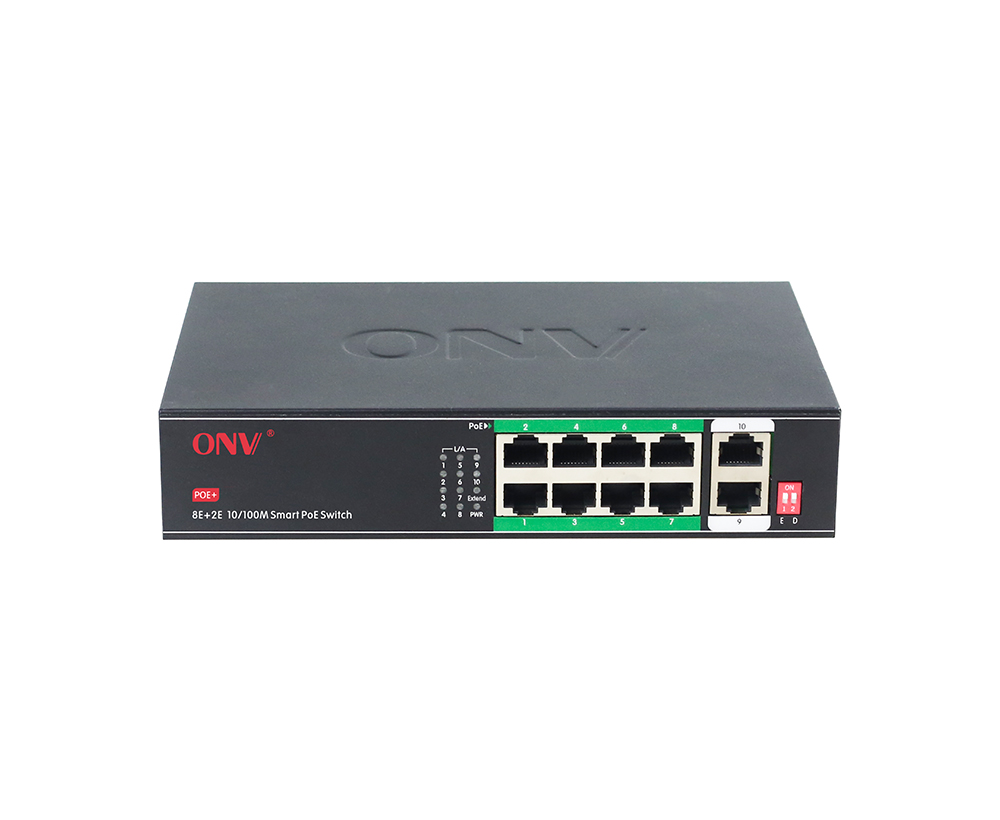
The ONV-H1016PLS is built for long camera runs: 16 PoE+ ports, 160W/250W budget versions and 10M/250-metre transmission — the class's answer to warehouses and perimeters.
| Parameter | Datasheet value |
|---|---|
| PoE ports | Port 1–16, PoE+ (IEEE 802.3 af/at) |
| Max power per port | 30W, PoE+ |
| Total PoE power | 160W / 250W versions (AC100–240V) |
| Switching capacity | 14.8 Gbps (non-blocking) |
| MAC address table | 16K |
| Buffer memory | 4M |
| Long-distance mode | 10M / 250 meters transmission on PoE ports |
The 16-PoE-port class is sized by a simple rule: count the powered devices on the segment, then leave at least two spare ports. Power matters as much as ports — add up the draw of every camera, access point or phone and compare it with the total PoE budget in the datasheet, not the headline per-port figure. Where the segment also carries uplinks to another switch or an NVR, prefer the models with dedicated gigabit or SFP uplinks so camera traffic never competes with the uplink.
Typical deployments for this class are detailed in the CCTV and IP camera solution pages; the same hardware also powers wireless access points, IP phones and access-control readers on the same segments.
One 16-port switch is simpler to power, mount and manage, and its shared budget lets high-draw devices borrow unused watts. Two 8-port units make sense when the devices split across two cabinets or buildings — in which case consider the industrial line for the remote node.
Sixteen fixed cameras at ~10W need ~160W; add PTZ or heated housings and the figure climbs fast. The catalogue's 16-port class runs from 160W to 250W versions — pick the budget after listing your devices, not before.
Send your port count, per-port power and uplink requirements — we reply with the exact models, datasheets and a quotation. MOQ and lead time are confirmed per model and order scope in the quotation.
Which control level your project needs.
How to size watts per port and per switch.