PoE Switch · By Port Count
Forty-eight PoE ports in a single rack unit is the density play: headquarters floors, hospitals, hotels and campuses where one switch powers every camera and access point on a floor — with 10G uplinks and full L2+ management.

Forty-eight PoE ports in a single rack unit is the density play: headquarters floors, hospitals, hotels and campuses where one switch powers every camera and access point on a floor — with 10G uplinks and full L2+ management.
Density concentrates risk as well as cabling, so this class is managed-only in practice: per-port PoE control, VLAN segmentation, link aggregation and SNMP monitoring are what make a 48-port segment operable. The catalogue tops out at 52-port models (48 PoE + 10G uplinks) in both the standard and L3 PoE lines.
Models in the 48-PoE-port class from the official catalogue (official product names).
| Model | Official product name |
|---|---|
| ONV-POE56036PFM | 10G uplink 36-port L2+ managed PoE switch |
| ONV-POE56052PFM | 10G uplink 52-port L2+ managed PoE switch |
| ONV-POE31048PF | Gigabit uplink 51-port PoE switch |
| ONV-POE36048PFM | 10G uplink 52-port L2+ managed PoE switch |
| ONV-POE36036PFM | 10G uplink 36-port L2+ managed PoE switch |
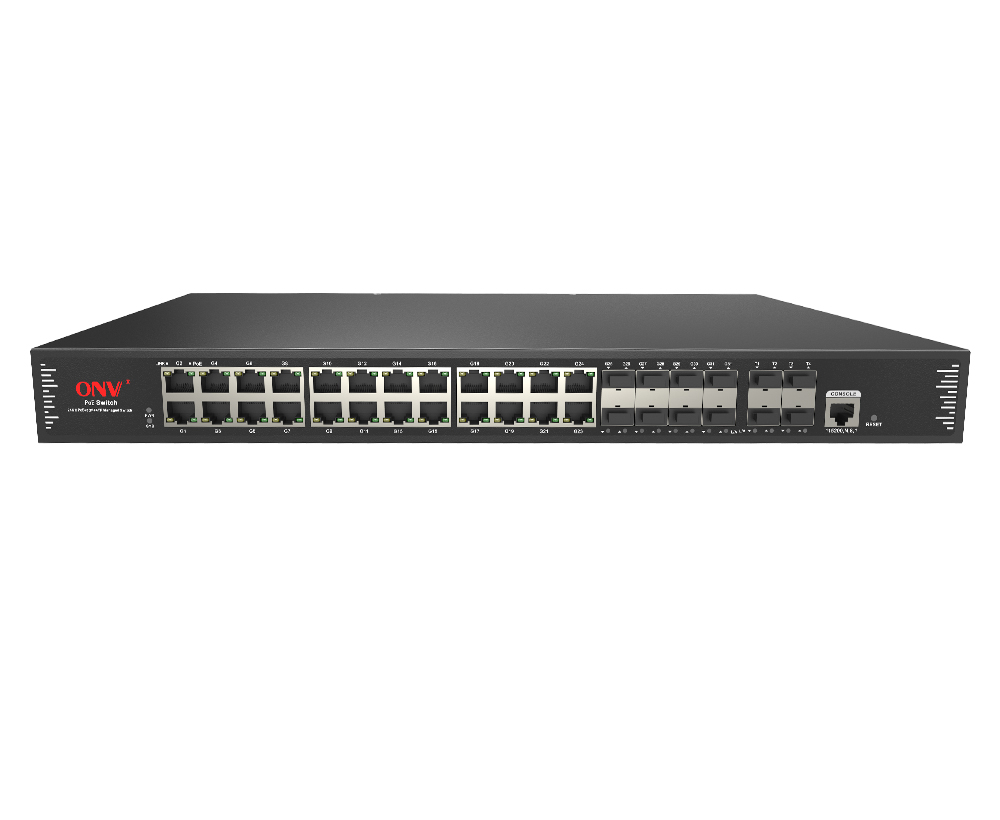
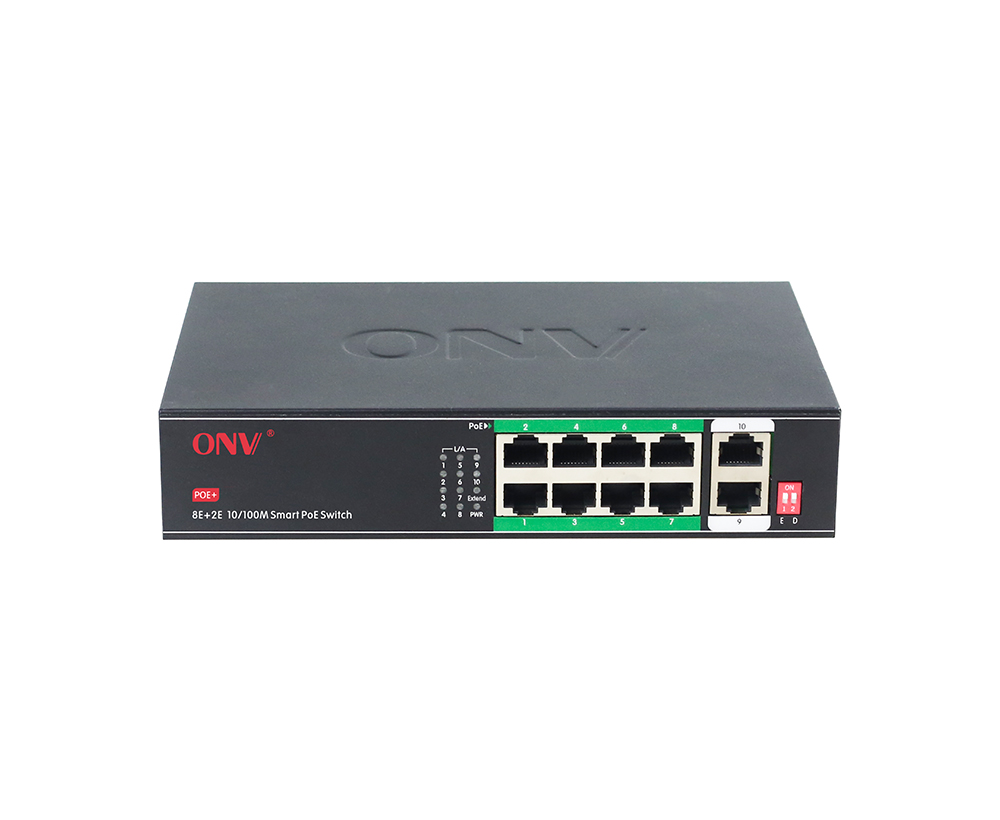
The ONV-POE56052PFM is the top of the port-count range: 48 PoE ports plus 10G uplinks (52 ports total), L2+ management, 216 Gbps switching capacity and 30W per port.
| Parameter | Datasheet value |
|---|---|
| PoE ports | Port 1–48, IEEE 802.3 af/at |
| Max power per port | 30W |
| Uplinks | 10G uplink ports (52 ports total) |
| Switching capacity | 216 Gbps (non-blocking) |
| Forwarding rate | 131 Mpps @64byte |
| MAC address table | 32K |
| Buffer memory | 16M |
| Console | 1 × RS232 console port |
| Standards | IEEE 802.3 / 802.3u / 802.3ab / 802.3z / 802.3ae 10GBase-LR/SR / 802.3x |
The 48-PoE-port class is sized by a simple rule: count the powered devices on the segment, then leave at least two spare ports. Power matters as much as ports — add up the draw of every camera, access point or phone and compare it with the total PoE budget in the datasheet, not the headline per-port figure. Where the segment also carries uplinks to another switch or an NVR, prefer the models with dedicated gigabit or SFP uplinks so camera traffic never competes with the uplink.
Typical deployments for this class are detailed in the CCTV and IP camera solution pages; the same hardware also powers wireless access points, IP phones and access-control readers on the same segments.
One 48-port unit halves rack space, power supplies and management points, and shares one large PoE budget. Two 24s give redundancy and let you split budgets across floors. For a single floor with one cabinet, the 48-port model is the cleaner build.
At full 802.3at load the theoretical figure is 48 × 30W = 1,440W, but real mixed loads are far lower — cameras draw 5–15W. Size by your actual device list and growth plan, and confirm the chosen model's total budget in its datasheet before ordering.
Send your port count, per-port power and uplink requirements — we reply with the exact models, datasheets and a quotation. MOQ and lead time are confirmed per model and order scope in the quotation.
Which control level your project needs.
How to size watts per port and per switch.